VADTel Sens
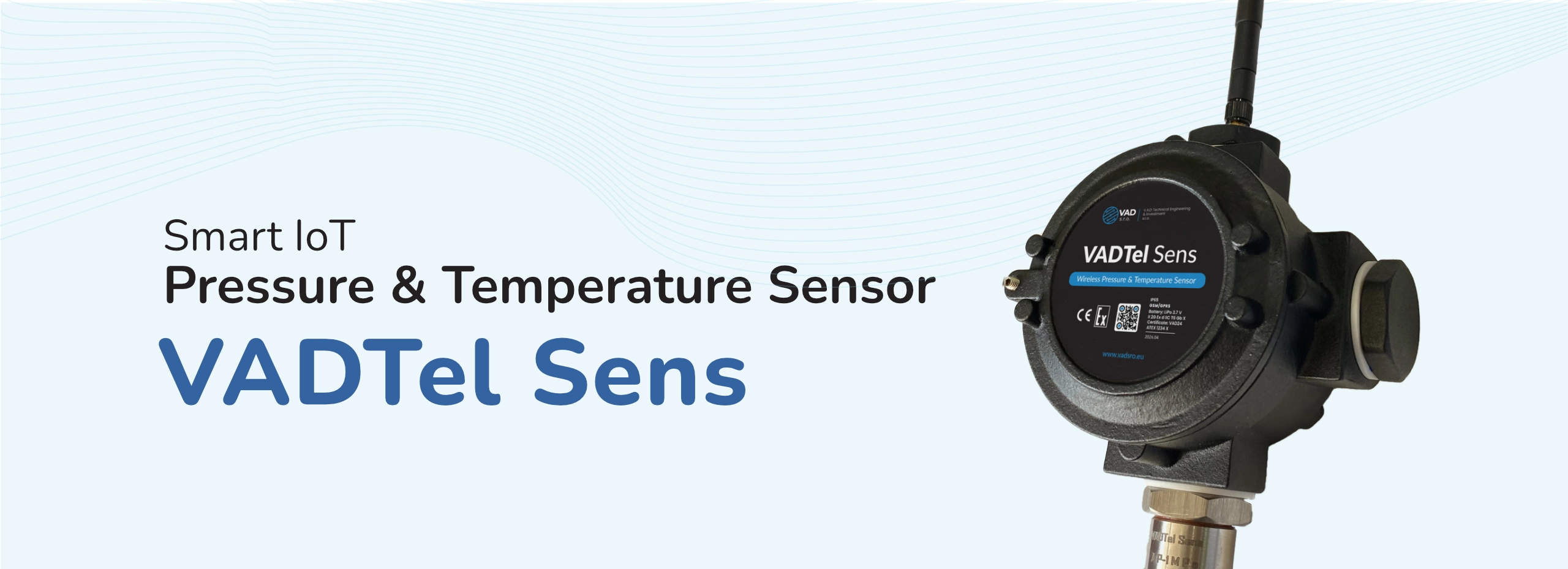
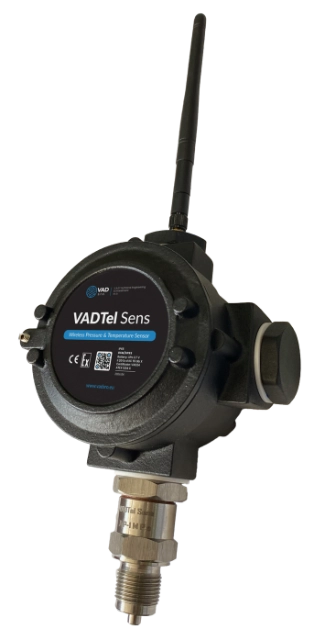
VADTel Sens is a smart cellular pressure and temperature sensor designed for autonomous monitoring of utility and industrial networks. The device combines gauge or absolute pressure measurement with integrated temperature acquisition and transmits telemetry through GSM/GPRS or NB-IoT to a secure Linux-based backend.
Overview
Key platform fit
- Pressure and temperature monitoring in one field-mounted sensor.
- Configurable telemetry with adjustable measurement cadence, heartbeat interval and alarm thresholds.
- Rechargeable LiPo battery options for long autonomous operation.
- Suitable for gas, water, heat and general industrial utility points.
Typical applications
- Gas distribution and pressure-reduction stations.
- Water supply networks, pumping stations and water-treatment systems.
- Heat supply systems, boiler rooms and district-heating substations.
- Hydraulic and pneumatic systems, including selected oil and fuel applications.
Operating logic
The sensor measures locally at a configurable interval. If the measured values remain within configured thresholds, the device returns to a low-power state and reports according to the heartbeat schedule. If a pressure or temperature threshold is exceeded, event-driven transmission starts and the dispatcher receives an alarm notification.
Process media and installation summary
VADTel Sens is intended for media compatible with stainless steel AISI 316L / AISI 304, including gases, steam, water and mildly aggressive liquids. The device is mounted similarly to a pressure gauge; pressure should preferably be introduced from below, with measures taken against vibration, severe pulsation, condensation and freezing where relevant.
Documented pilot-operation evidence
Published pilot reports describe approximately 4,000 server sessions in 7 months on one low-pressure unit and approximately 10,000 sessions in 17 months on another, without battery replacement during the test period.
Technical specifications
Measurement
| Parameter | Value |
|---|---|
| Pressure type | Gauge or absolute |
| Pressure accuracy | ±1.0 / ±1.5 / ±2.0 / ±2.5 %FS |
| Permissible overload | 1.5 × full scale |
| Process temperature range | -40…+85 °C |
| Temperature accuracy | ±1.0 °C standard; ±0.1 °C option |
Telemetry & control
| Parameter | Value |
|---|---|
| Cellular communications | GSM/GPRS or NB-IoT |
| Measurement interval | 5…600 s |
| Heartbeat / health report | 30 min…24 h |
| Alarm-zone reporting interval | 5…60 min |
| Alarm thresholds | Server-configurable min./max. pressure and temperature limits |
| System integration | Secure Linux backend; IIoT / OPC UA / SCADA |
Power
| Parameter | Value |
|---|---|
| Power supply | Built-in rechargeable LiPo battery, nominal 3.7 V |
| Battery capacity options | 2000 / 4000 / 6000 mAh |
| Guaranteed telemetry sessions | 5,000 / 7,500 / 10,000 server sessions |
| Autonomous operation | Up to 5 years typical; application-dependent |
| Battery service | Recharge / replacement by authorized service personnel only |
Environmental & mechanical
| Parameter | Value |
|---|---|
| Ambient operating temperature | -40…+60 °C |
| Storage / transport | -50…+60 °C; up to 95% RH at +35 °C |
| Ingress protection | IP65 (IEC 60529) |
| Process connection | M20 × 1.5 |
| Wetted media compatibility | Stainless-steel-compatible media (AISI 316L / AISI 304) |
| Housing / installation form | Field-mount sensor; installed similarly to a pressure gauge |
| Dimensions | Approx. 125 × 210 × 90 mm |
| Weight | Approx. 1.0-1.2 kg, depending on housing/options |
| Recommended recalibration interval | 36 months |
Available pressure ranges
- Gauge: low-pressure gas-network variant and 0…40 kPa version.
- Absolute: 0…160 kPa, 0…400 kPa, 0…600 kPa, 0…1.0 MPa, 0…1.6 MPa, 0…2.5 MPa, 0…4.0 MPa.
- Custom ranges up to 60 MPa on request.
Low-range source materials reference both 5 kPa and 7 kPa variants. Confirm the exact low-pressure range in the RFQ or order sheet.
Configuration options
- Accuracy class: ±1.0 / ±1.5 / ±2.0 / ±2.5 %FS.
- Battery: 2000 / 4000 / 6000 mAh.
- Remote temperature probe option.
- Process cooler with remote temperature probe option.
- Hazardous-area housing version.
Standard delivery / accessories
- Sensor unit.
- External GSM / NB-IoT antenna.
- Product passport / datasheet.
- Operating manual and calibration method on request.
Engineering notes
- The datasheet uses EU / IEC terminology such as
%FSand IEC 60529 ingress ratings. - Ambient operating temperature and measured/process temperature are stated separately.
- Conservative ratings were selected where legacy source documents differed.
- Final product definition remains configuration-specific.
Remote setpoint configuration interface
Dispatcher-side configuration allows remote adjustment of the measurement interval, reporting schedule and min./max. alarm thresholds for each channel. During normal operation the sensor reports according to schedule; when configured pressure or temperature limits are exceeded, the device switches to event-driven reporting until the alarm condition clears.
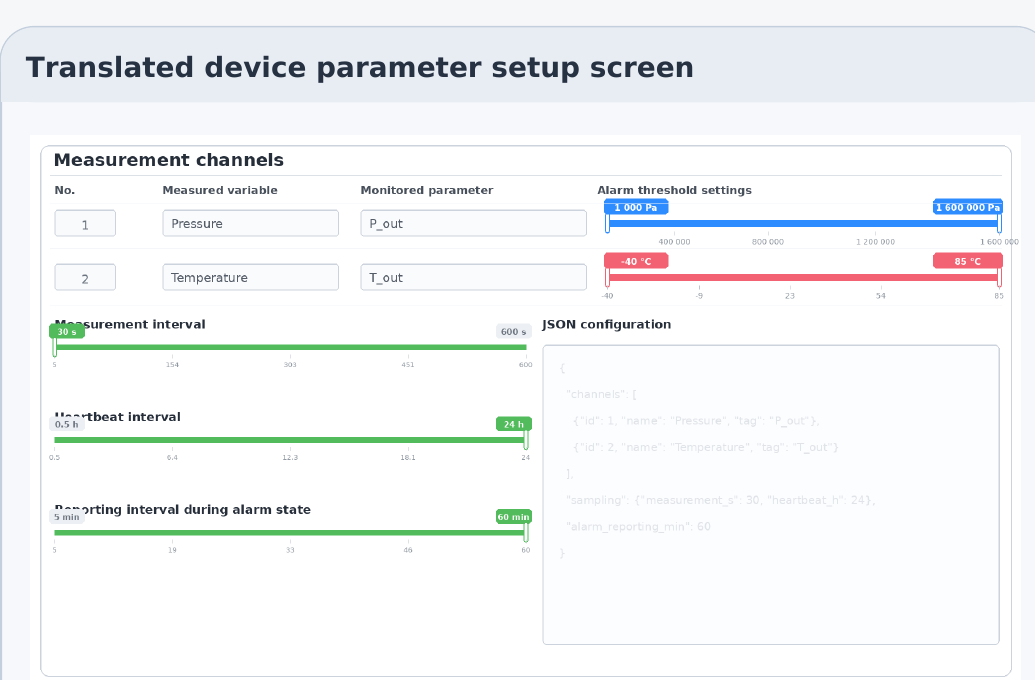
What the translated screen shows
- Pressure
P_outand temperatureT_out. - Alarm threshold bars for both channels.
- Measurement, heartbeat and alarm-state intervals.
- JSON view of the active configuration.
EU compliance and installation notes
Regulatory adaptation for the EU market
- A manufacturer RoHS declaration is published for V.A.D. products in accordance with Directive 2011/65/EU and Delegated Directive (EU) 2015/863.
- For a marketed cellular version, the applicable EU legislation typically includes RED 2014/53/EU, RoHS 2011/65/EU and WEEE 2012/19/EU.
- The hazardous-area version described in EU: CE 1354 II 2G Ex d IIC T6 Gb X
- Use in hazardous areas within the EU requires a version carrying valid ATEX / IECEx marking together with the corresponding declaration and certificate set.
- CE marking is product-specific and may only be applied after final conformity assessment of the placed-on-market EU variant.
No unverified CE or ATEX claim is made on this page.
Installation and service precautions
- Mount similarly to a pressure gauge and apply mechanical load only to the process connection, not to the housing.
- Avoid severe vibration, shocks and pressure pulsation above approximately 10% of nominal range.
- If process temperature exceeds the permitted device limit, use an impulse line or cooler.
- Protect the housing against condensation and freezing in low-temperature service.
- Do not open the unit in a hazardous area; battery service must be carried out by authorized personnel only.
Configurable telemetry workflow
- Measure - Pressure and temperature are measured locally every 5…600 seconds.
- Compare - Measured values are checked against configured minimum and maximum thresholds.
- Sleep / heartbeat - If values are normal, the unit returns to low power and reports every 30 min…24 h.
- Alarm report - If thresholds are exceeded, event-driven transmission starts every 5…60 min until the condition clears.
Published field evidence
- A interregional-gas pilot protocol documents approximately 4,000 server sessions in 7 months on one test unit and approximately 10,000 sessions in 17 months on another test unit.
- The same pilot notes average monthly traffic of approximately 60 kB and regular reporting by schedule and on threshold events.
- A pilot letter reports 93-94% remaining battery charge after 267 communication sessions in a pilot installation and observed pressure-measurement accuracy not worse than ±20 Pa on a 0…40 kPa unit.
Tender / order-sheet checklist
- Pressure type: gauge or absolute.
- Required pressure range and accuracy class.
- Battery capacity and expected reporting profile.
- Communication technology and antenna arrangement.
- Need for remote temperature probe or cooler.
- Whether a hazardous-area certified variant is required for the final EU installation.
Notiz
All parameters are configuration-dependent and subject to final application review.